Water Bath vs. Pressure Canning for Marmalade: Safety and Texture Compared
There's a moment in marmalade making when the shreds turn translucent and the syrup sheets off a cold spoon. Then you're standing over a pot of bitter orange gold, wondering how exactly to seal it. Water bath or pressure canner?
For marmalade, the answer is almost always the water bath. A pressure canner isn't dangerous here—it's just a heavier tool doing a job a rolling boil already does, and it charges you in texture. Here's what's actually happening in each pot, and when the exception applies.
Acidity Settles the Question First
Canning methods aren't a matter of preference. They follow the acidity of the food.
Pressure canning exists to reach around 240°F (116°C), the temperature needed to destroy Clostridium botulinum spores in low-acid foods: green beans, corn, stock, meat. Marmalade doesn't need that heat. Citrus fruit and the sugar syrup around it are high-acid, typically within a pH range of roughly 3 to 3.5. Botulism spores can't grow in that environment, so a boiling water bath at 212°F (100°C) is enough to create the vacuum seal that keeps your jars shelf-stable.
The trap is improvisation. The moment you start treating marmalade as a base for other things—adding carrot, pumpkin, red pepper, tomato, or a lot of extra water—you've lowered the acidity, and the rules change. Stick to tested recipes from a reliable source, or check the pH yourself with strips. If you're unsure about a batch, refrigerate it and eat it within a few weeks rather than gambling on the shelf. For anything involving low-acid additions or a household member with a compromised immune system, it's worth checking with your local extension service or a food-science professional.
Water Bath Canning, Step by Step
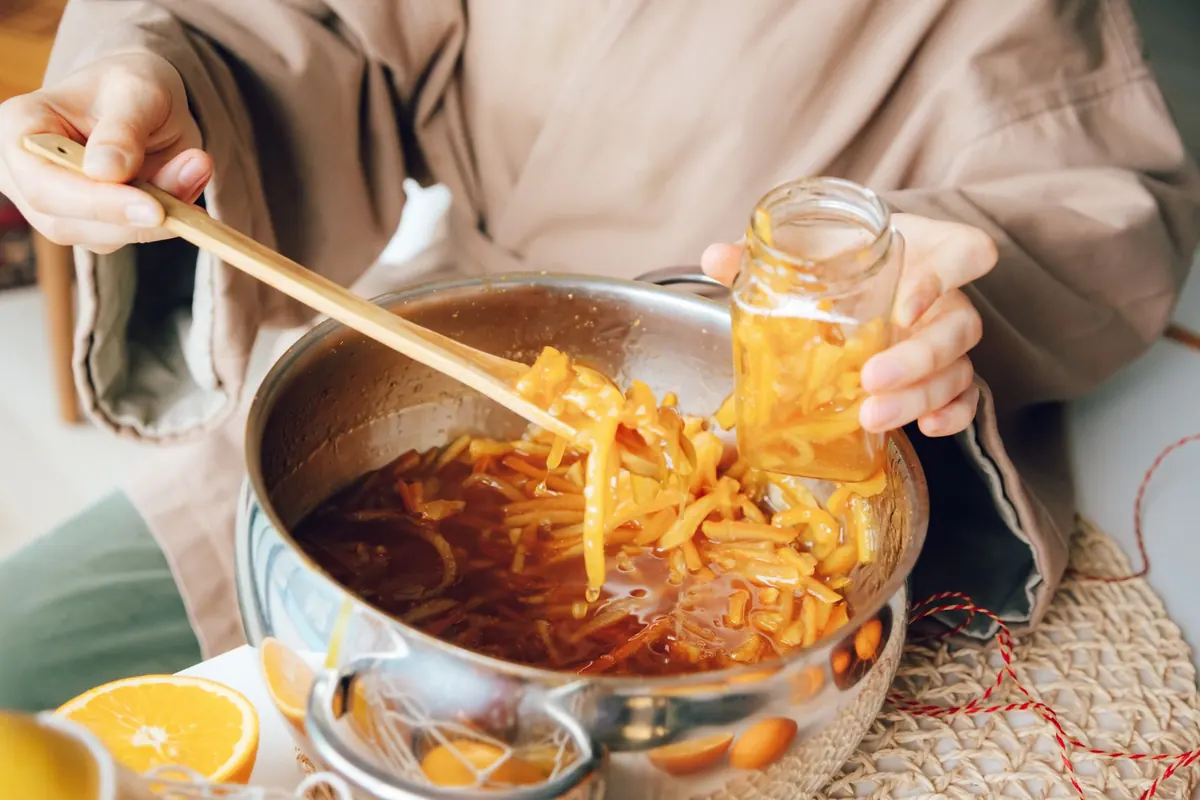
A water bath canner is a deep pot with a rack. A heavy stockpot works if it's tall enough that jars can be covered by 1 to 2 inches of water. Here's the sequence:
- Prep jars. Wash them in hot soapy water. If your tested recipe calls for processing under 10 minutes, sterilize the jars in boiling water first, since the short process won't do it for you.
- Fill hot. Ladle marmalade into hot jars, leaving 1/4 inch of headspace. Run a plastic spatula around the inside to release air bubbles, then recheck the level.
- Wipe and lid. Wipe the rim with a damp cloth—any sticky film will break the seal. Centre a two-piece lid and tighten the band to fingertip-tight.
- Lower into the pot. Jars go on the rack without touching each other, and the water must sit 1 to 2 inches above the lids.
- Boil and time. Cover, bring to a full rolling boil, then start your timer. Half-pints and pints of marmalade typically need somewhere in the region of 5 to 15 minutes at sea level, depending on jar size and the tested recipe. Add time for altitude—water boils cooler the higher you go—using your recipe's chart.
- Rest, then lift. Turn off the heat, remove the lid, wait about 5 minutes, then lift jars with a jar lifter onto a towel.
- Cool undisturbed. Leave them 12 to 24 hours. You'll hear the lids ping. Then check the seal by pressing the centre—no flex means sealed—and remove the bands for storage.
One useful trick: a pressure canner can double as a water bath canner. Leave the lid off, or set it on with the vent open and the lid unlatched, keep jars on the rack and covered by water, and you've got a perfectly good boiling water setup.
What the Pressure Canner Does to a Batch
Pressure canning marmalade is safe—more heat never makes a high-acid food less safe. The cost is quality, and it's a real cost.
You're adding heat on both ends. A pressure canner needs to be vented before it pressurizes, then it holds at temperature, then it depressurizes slowly. A batch that spends 10 minutes in a water bath might spend 40 to 50 minutes in the canner once you count the come-up and cool-down. That's a lot of extra cooking for delicate shreds and set pectin.
You also can't watch it. Siphoning—where liquid pushes out under the lid and leaves a sticky film down the jar—is more common under pressure, and a jar that loses syrup loses set. And because the lid is clamped on, you can't nudge a jar or spot a problem until the whole cycle finishes.
The Texture Difference You Can Taste
Pectin is the backbone of a good set, and it's heat-sensitive. Push marmalade to 240°F and you start breaking down the very structure that makes it firm. Practical results:
- Set: Water-bathed marmalade sets to a brighter, cleaner gel. Pressure-canned batches often land softer, sometimes syrupy.
- Shreds: Fine-cut peel keeps a little bite in a water bath. Under pressure, shreds turn soft and can collapse into the jelly.
- Colour: Longer heat means duller amber and darker edges. Water bath keeps that bright, backlit orange.
- Flavour: Extra heat drives off volatile citrus oils and edges toward caramel. Some people like the deeper note; most find the freshness muddier.
None of this means a pressure-canned jar is ruined. It means you've spent more fuel and more time to get a softer, darker marmalade than the one you'd have got from a plain pot of boiling water.
When Pressure Canning Is Worth Considering
There is a narrow case for it: marmalade variations built on low-acid ingredients. Think pumpkin or sweet potato "marmalade," tomato jam with citrus peel, or a pepper-and-orange preserve. Once the base ingredient is low-acid, water bath processing is no longer automatically sufficient, and you need a tested pressure-canning recipe with specific pressure and timing for your altitude and canner type—dial gauge or weighted.
For anything citrus-led with normal sugar levels, that situation doesn't apply. Strain the peel, taste the syrup, and reach for the stockpot.
The Practical Verdict
Boil the filled jars in water, 1 to 2 inches over the lids, and time them per your tested recipe and altitude. That's the whole method for citrus marmalade, and it gives you the firm set, bright colour and intact shreds that made you start cooking in the first place.
Save the pressure canner for vegetables, stocks and low-acid preserves—or use it as an oversized water bath pot. Before you start, do the set test: a spoonful on a chilled saucer, pushed with a finger. If it wrinkles, it's ready for the jars. If it runs, keep boiling.
Photo: Ron Lach / Pexels